


On 2 February 2025, Elex Media Komputindo, the publisher of the Indonesian language edition of the Detective Conan manga series, held a special event at Gramedia Matraman bookstore in Jakarta to mark the launch of the manga’s 105th volume in Indonesia. Held in collaboration with fan communities such as the Conan Fans’ Club and the Keigo Higashino fans club, the event featured an exhibition of manga materials and a discussion about the manga’s influence on mystery fiction. According to Elex’s count of the attendance registration, the event had recorded 600 registered attendants, a remarkable showing of the fandom’s size and enthusiasm.
Created by Gosho Aoyama, Detective Conan has been the longest-running manga series of Weekly Shonen Sunday magazine after more than 30 years of serialisation, and an anime series based on the manga has also been in production continuously since 1996. In Indonesia, Detective Conan has been one of the biggest shonen manga titles. The official Indonesian edition of the series has been available before the so-called “big three” titles of Weekly Shonen Jump (One Piece, Naruto, Bleach) had official Indonesian editions, and its sales rival those three or have even surpassed them at times.
Not only the main series, but Elex Media has also published Detective Conan‘s various other print media, like spin-off comics and novels. On the anime side, the TV series has been shown by different Indonesian TV channels over the years, while the annual anime films have been consistently shown in Indonesian cinemas since 2014’s Dimensional Sniper. Furthermore, at the time of this writing, a themed cafe presented by the Gramedia-Kadokawa joint venture Phoenix Gramedia Indonesia is taking place from 19 June to 3 August 2025 at three Milou Farm House restaurant locations. The series also boasts a dedicated fanbase, with Conan Fans’ Club being a prominent and active organised community of its fans with members across Indonesia’s various islands.
Given Detective Conan‘s history of popularity in Indonesia, to commemorate the release of the manga’s 100th volume in Japan and the broadcast of the anime’s 1000th episode in 2021, KAORI Nusantara made an effort to get a better picture of the series’ entry and reception in the country. There were two methods that KAORI employed to gather the data for this purpose. First, KAORI held an online survey for Indonesian fans regarding their consumption and reception of Detective Conan media. Second, KAORI invited the editor for Detective Conan from Elex Media, Binarti, and representatives from Conan Fans’ Club, Alfa and Panji, to discuss the series’ popularity in Indonesia in a podcast on 16 October 2021. Elex Media’s editors and the Conan Fans’ Club also cooperated to share the survey form.
The survey itself received 205 valid responses between 4 October 4 to 11 October 2021. The respondents were balanced between female and male fans, with 98 respondents (47.8%) identifying as female and 92 respondents (44.9%) identifying as male, with 12 respondents (5.8%) choosing not to disclose information about their gender, 2 respondents identifying as non-binary, and 1 respondent choosing “other”.
Most of the respondents were young adults born sometime between 1990 and 2002. 78 respondents (38%) were 19-24 years old at the time of the survey, and 67 respondents (32.7%) were 25-31 years old. Then, there were teenagers aged 16-18 years with 20 respondents (9.8%), adults over 31 years with 19 respondents (9.3%), and teenagers between 13-15 years old comprised 16 respondents (7.8%).
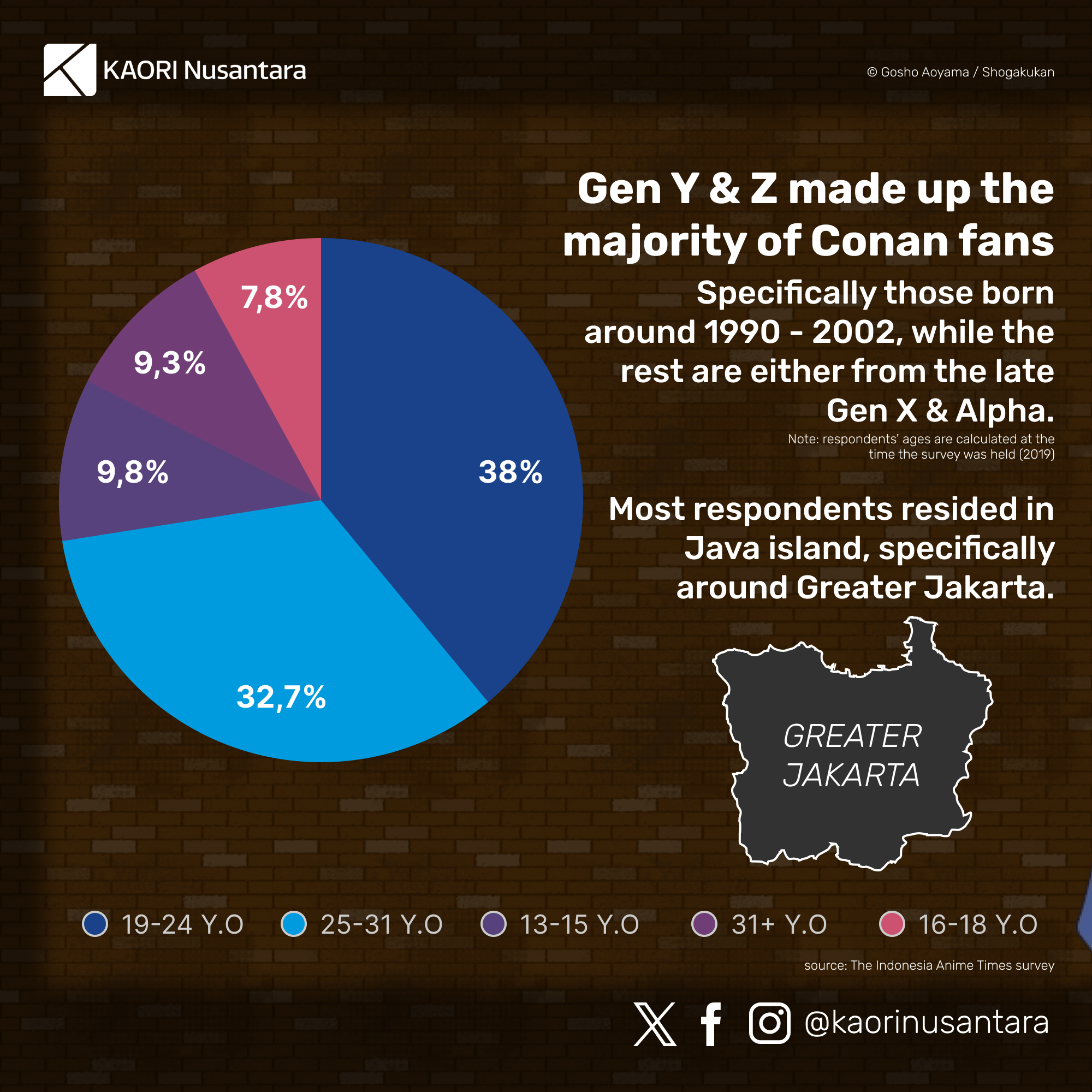
The majority also resided in the island of Java, with the largest group residing in the Greater Jakarta area (62 respondents), followed by the provinces of West Java (excluding Bogor, Depok, Tangerang, and Bekasi) and East Java (30 respondents each). The island of Sumatra contributed the next largest number of respondents (33 respondents), and while the numbers weren’t big, there were also respondents from Bali, Kalimantan, and Sulawesi.
In this article, we will use excerpts from the podcast discussion and data from the survey to construct a narrative about the manga’s publication in Indonesia, its reception, and the growth of its fandom. Through this narrative, we aim to shed light on why the manga continues to be beloved by Indonesian fans for more than two decades.
Origins
The star of Detective Conan is Shinichi Kudo, a brilliant high school detective nicknamed “the Heisei Holmes”. While on a trip to an amusement park with his love interest, Ran Mouri, to celebrate her win at the regional karate championship, Shinichi witnessed two black-suited men performing an illegal trade. The men discovered him and tried to kill him by feeding him an experimental poison; however, unknown to them, the poison shrank his body to the size of a child instead.
At the suggestion of his neighbour, the eccentric inventor Professor Agasa, Shinichi concealed his identity with the pseudonym Conan Edogawa. As Conan, he stayed with Ran and her private investigator father, Kogoro Mouri, secretly helping Kogoro to solve cases while investigating the men in black and the mysterious organisation they belong to in order to find a way to return to his original body.
Detective Conan began its serialisation in Weekly Shonen Sunday in January 1994. According to the creator, Gosho Aoyama, the series was made at the suggestion of his editor at Shonen Sunday at that time to compete with Kindaichi Shonen no Jikenbo, the detective manga of Sunday‘s rival, Weekly Shonen Magazine.
Surprisingly, the path for Detective Conan to be published in Indonesia began quite early. Binarti recounted that when Elex’s editors visited Sunday‘s publisher, Shogakukan, in late 1993, the editors were already asked if they were interested in Sunday‘s upcoming detective manga. Seeing a prospect for detective fiction, Elex picked up the offer, and through lengthy negotiations, the first volume of the Indonesian edition of the manga was launched in early 1997. However, she also mentioned that the manga was not an instant hit, only starting to pick up buyers after a couple of volumes.
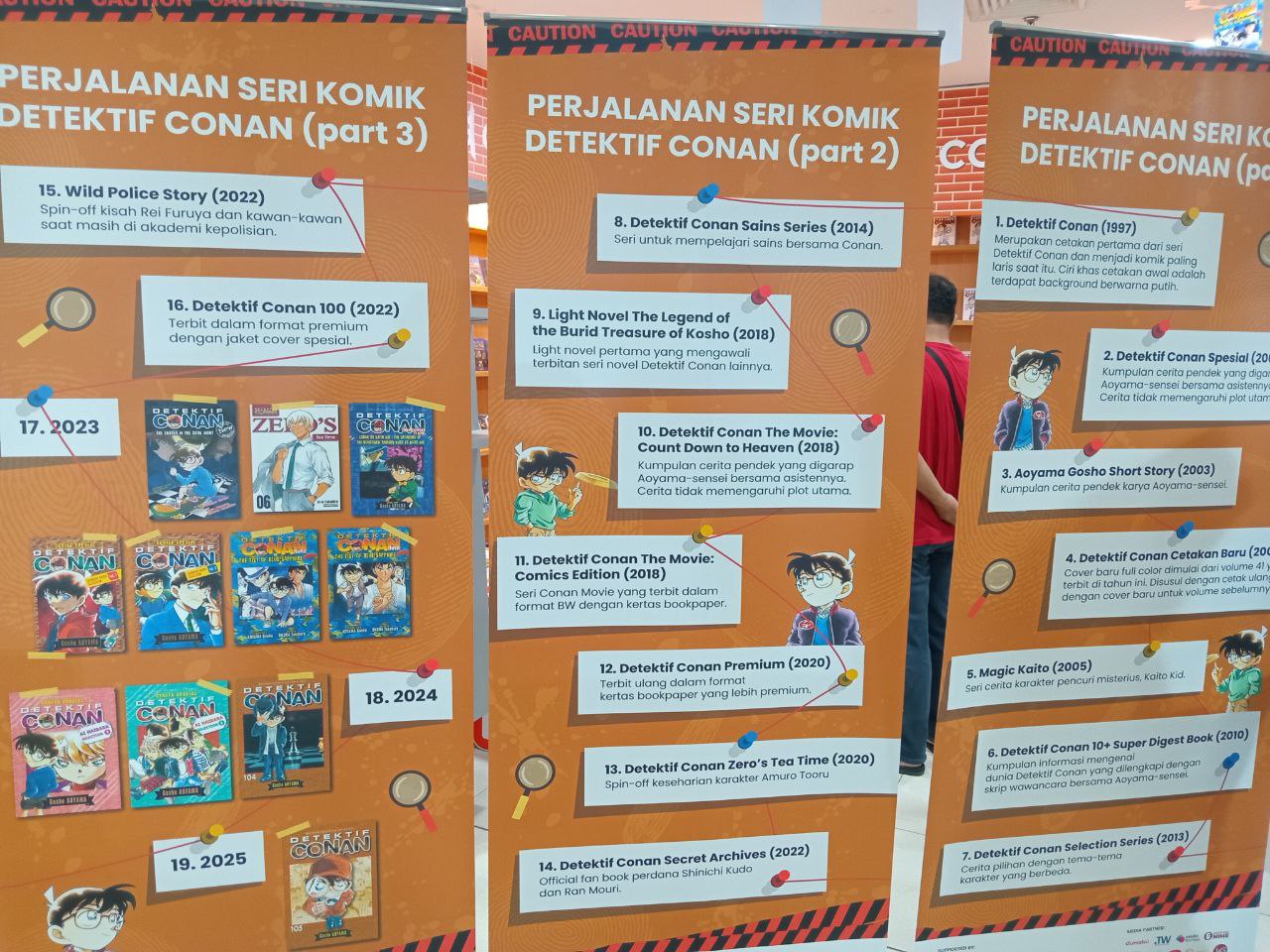
Given the age composition of our survey respondents, it’s no surprise that around two-thirds of the respondents have known Detective Conan since the first decade of the series being available in Indonesia. 62 respondents (30.2%) have known it since 1996-2001, and another 62 respondents have known it since 2002-2007. The next largest group are 43 respondents (21%) who have known it since 2008-2013, followed by 24 respondents (11.7%) who have known it since 2014-2019, and 14 respondents (6.8%) who have known it since 2019.
The survey also indicates that the anime series played an important role in introducing Detective Conan to the Indonesian audience, with 104 respondents (50.7%) claiming to have first known of it from the TV anime series. But the manga came close as a gateway, with 92 respondents (44.9%) having known of Conan from the manga first. And although just a few, two respondents did mention getting introduced to the series by a parent or another family member.
The different routes to be introduced to Conan are also represented by our podcast guests from the Conan Fans Club. Panji is one of the older generation of fans, being introduced to it around 2001 through getting the manga’s first volume, which was also his first comic. Meanwhile, Alfa just started to get absorbed into the series from watching a TV broadcast of one of the films in 2016, and he went through all the films first before getting into the manga.
Detective Conan Media Use Patterns
Now that we have a picture of how our respondents got introduced to the series, let’s explore in detail what Detective Conan media they routinely engaged with and what channels they typically used to engage with those media. For most of the following questions, we allowed the respondents to choose more than one answer, as the fans do enjoy multiple media in the series and make use of a variety of channels to do so.
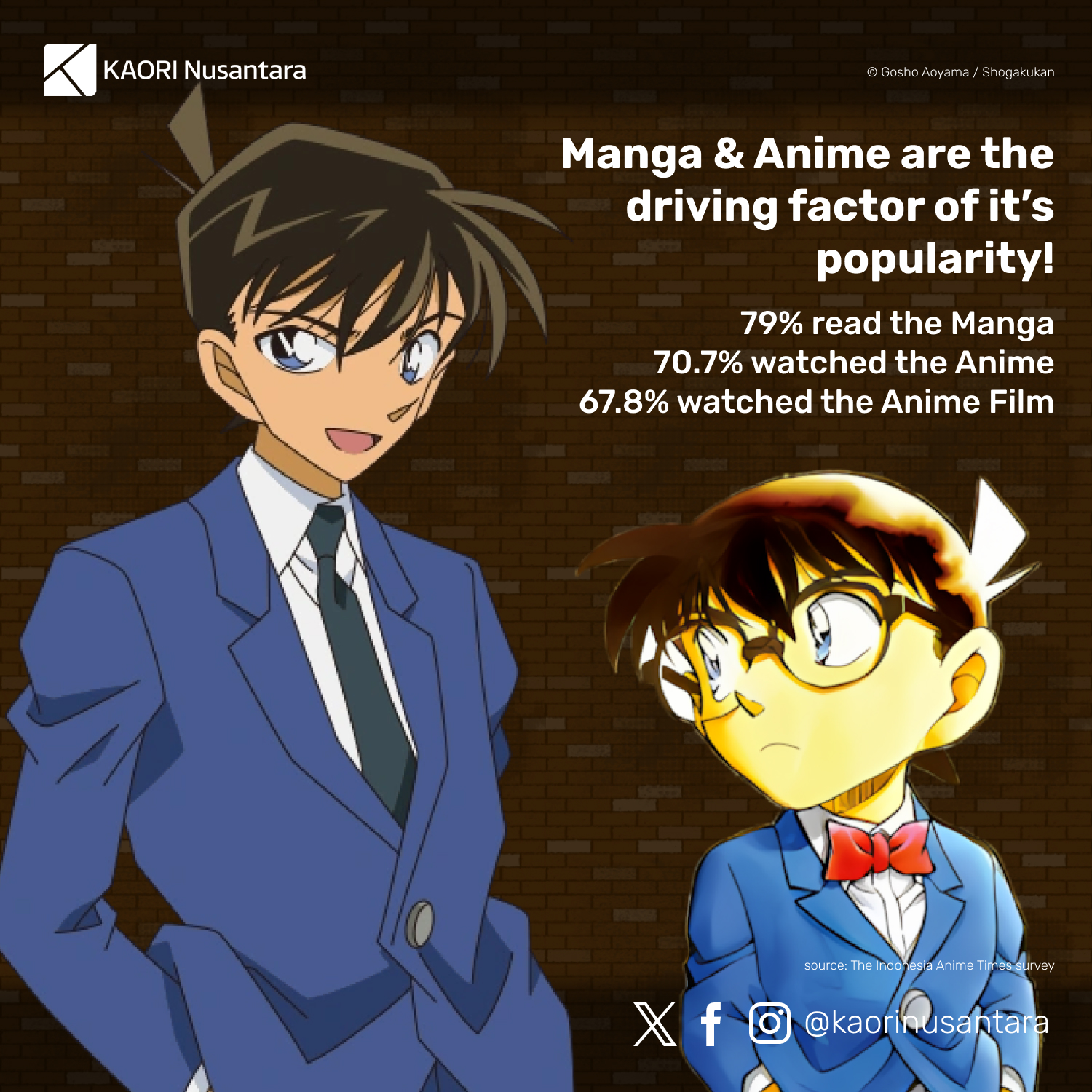
Our survey reveals that the mainline manga series and the anime were, indeed, the primary media our respondents routinely used. From the responses we received for this question, routinely reading the manga made up 79% (162 responses), followed by routinely watching the TV anime series with 70.7% (145 responses), and routinely watching the annual films with 67.8% (139 responses). Other print media weren’t as many, with up to 30.7% (63 responses) for routinely reading the spin-off manga, only 16.1% (31 responses) for routinely reading the official references (e.g. Super Digest Books or Secret Archives), and only 16.1% (31 responses) for routinely reading the novels.
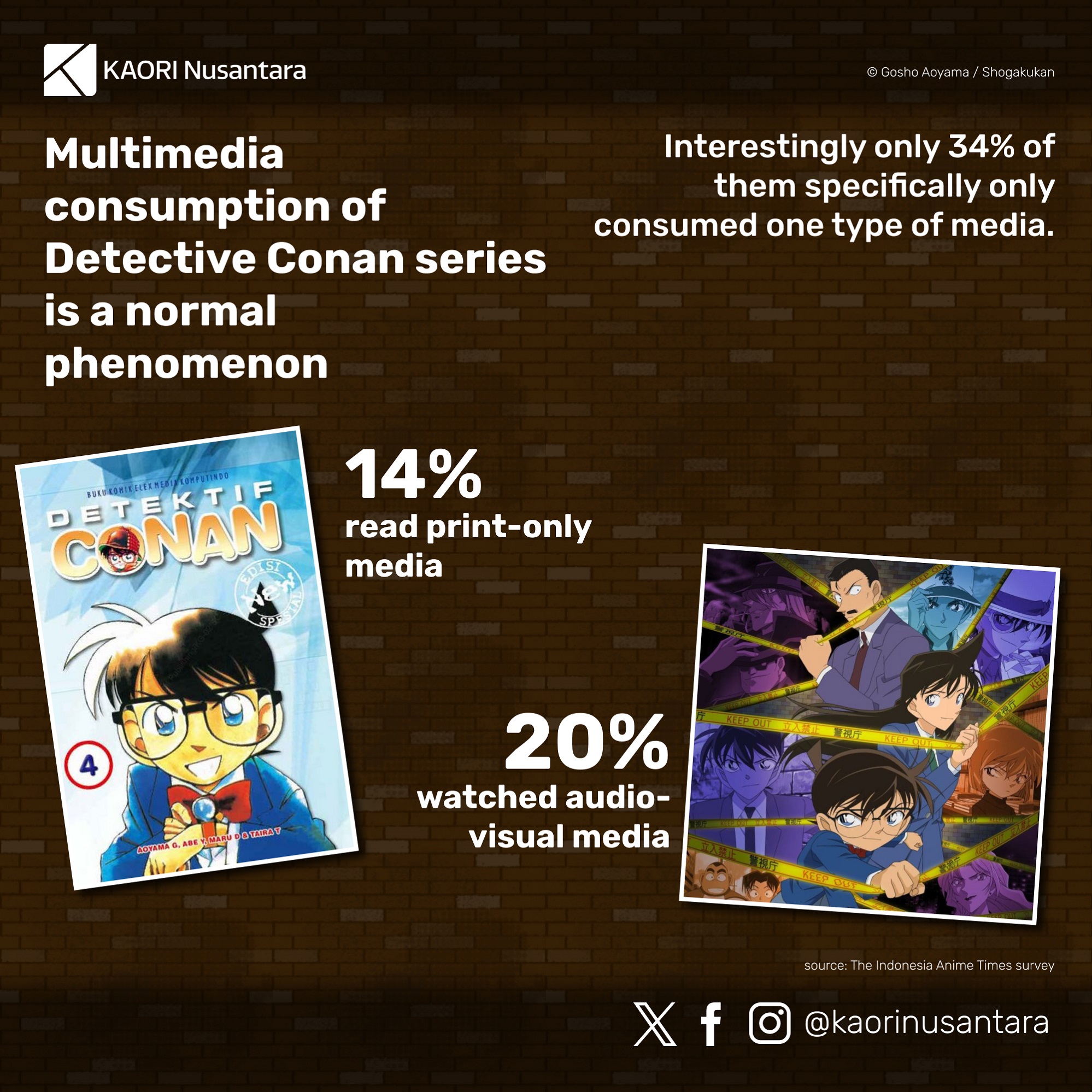
As mentioned earlier, most fans enjoy multiple Detective Conan media rather than exclusively sticking to one of them. From our survey, only 20 respondents exclusively consumed the mainline manga, and overall, only 29 respondents exclusively consumed print media. On the anime front, 41 respondents exclusively consumed the anime, and out of that number, only 15 respondents exclusively consumed the TV series, while 6 respondents exclusively consumed the annual films.
Despite this fact, though, at least up to the time when Editor Binarti was interviewed in our podcast, Elex Media had not done much collaboration with the Conan anime’s rights holders, at most just joining as a sponsor for the films’ screenings in cinemas, but not with the TV series’ broadcasts. This, she explained, is because Elex Media only have the rights to publish the manga, and not for other stuff, such as merchandising.
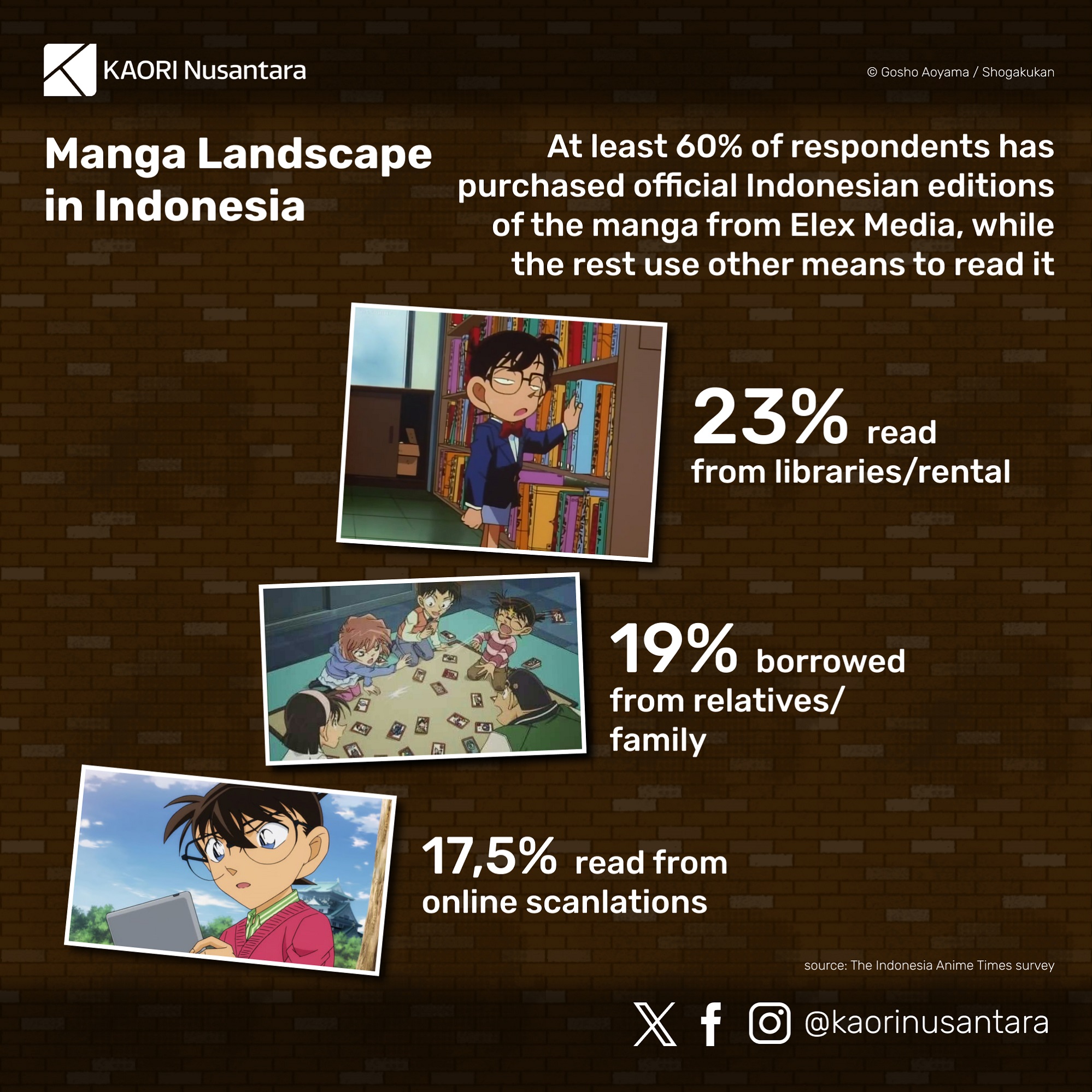
Next, how did our respondents access those media? Let’s begin with the manga front. Our survey found that 125 respondents routinely purchased the Indonesian editions released by Elex Media. Other means to read the manga in print included reading the manga at libraries or comics rental shops (48 respondents) or borrowing the manga from friends or family members (39 respondents). While only a few, six respondents, owned the original Japanese editions, with two respondents owned other foreign language editions. However, all the respondents in both groups still purchased Elex Media’s releases too. Another unique response is from one respondent who claimed to buy only the manga volumes that have stories featuring the character Kid the Phantom Thief.
Compared to that, 56 respondents disclosed that they read scanlations of the manga, and even then, 39 of them or more than two-thirds, still purchased Elex Media’s releases too. Meanwhile, legal digital options were still not as popular, with only 36 respondents using them.
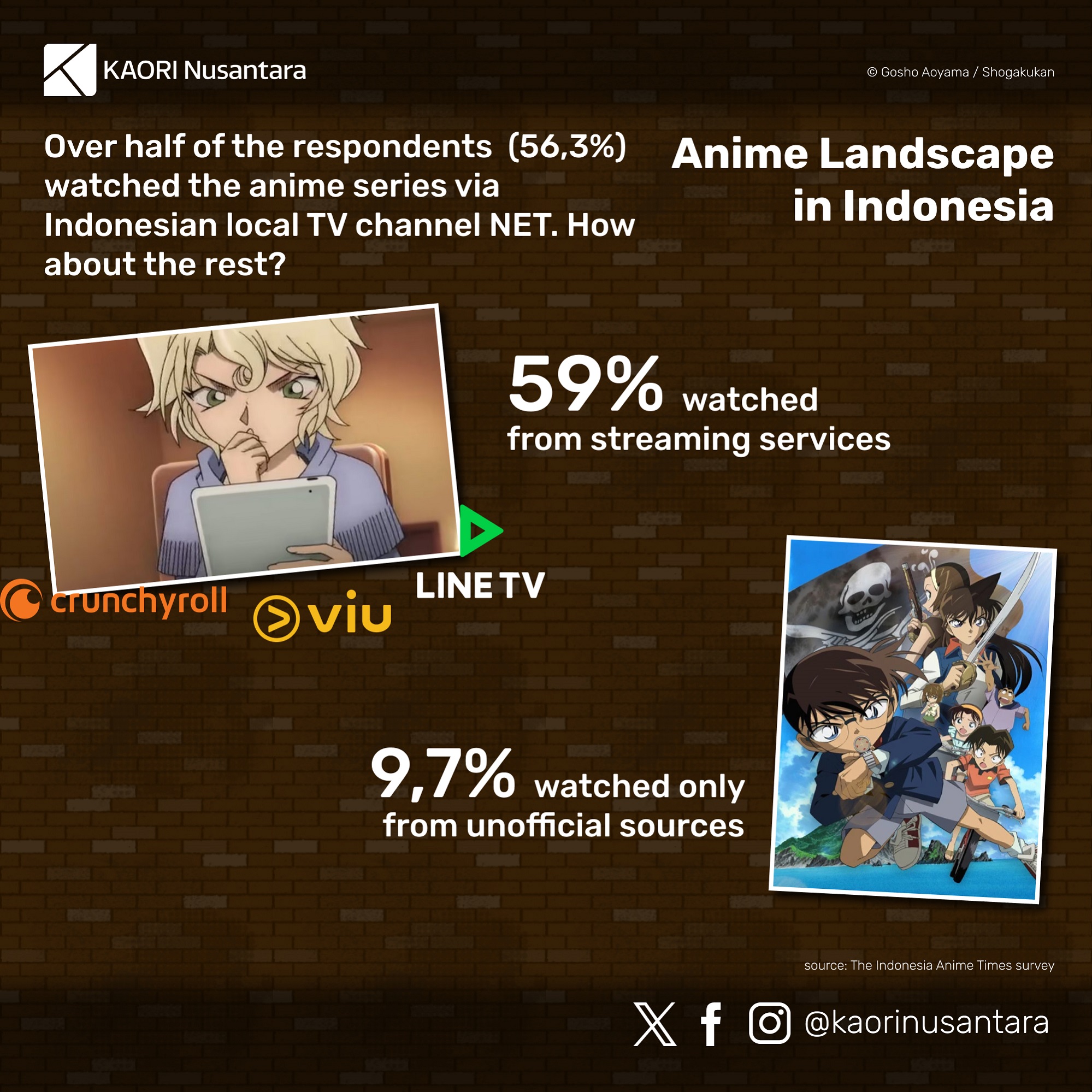
Moving on to the anime, at the time of the survey, 116 respondents had been watching the TV series on NET, the domestic channel that aired the series in Indonesia at the time. Many legal streaming services were also available as options, with Viu being the choice of 62 respondents, 38 respondents tried LINE’s streaming service, and 22 respondents claimed to watch the show on Crunchyroll. Compared to the consumption of manga, the usage of illegal means to watch the TV series is higher, at 100 respondents. However, 80 of those respondents had also watched the show on domestic TV or on legal streaming services.
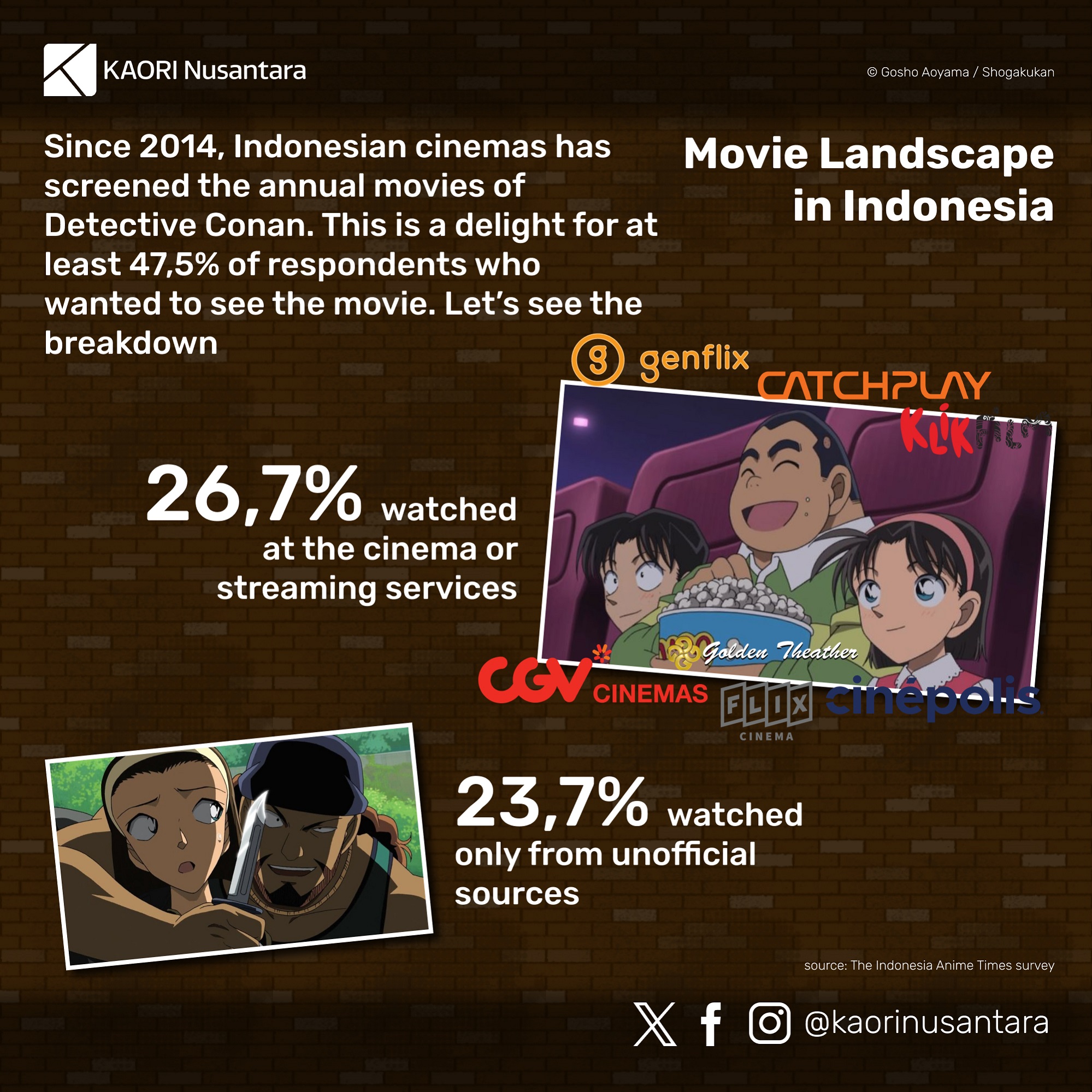
With the annual films regularly screened at Indonesian cinemas since 2014, going to the cinema has become an important means for 98 of our respondents to see the films. The films had also come to be available on a number of streaming services, with KlikFilm being the most popular choice with 26 respondents using it, while only 10 used Catchplay Plus and only 5 used Genflix (the films were not yet available on Netflix at the time of the survey). Physical copy was not a popular option, with only 12 claimed to watch the films on home video. Notably, 104 respondents disclosed that they watched the films through illegal channels. Although again, many users of illegal means also use legal options, with 55 of them also watched the films at the cinemas, on legal streaming services, or on home video.
What the Fans Like from Detective Conan
Having known the different types of Detective Conan media used by our respondents, now let’s explore the things they liked about the series. We asked what aspects they liked from the stories, which characters and pairings they liked, and what their favourite story arcs and films were. Again, we allow respondents to pick more than one answer to these questions.
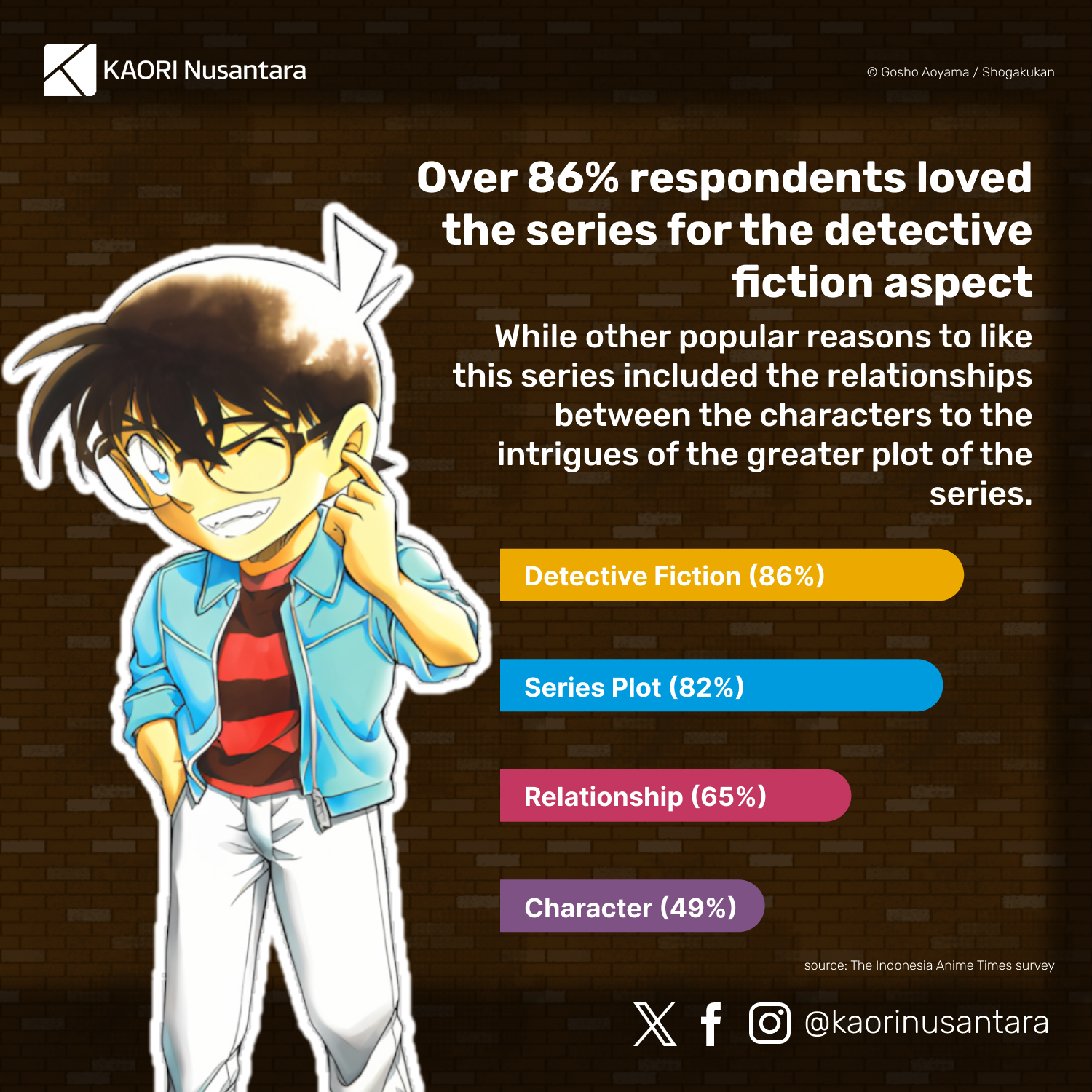
In regard to the aspect of the story that the respondents like, perhaps unsurprisingly for a detective fiction, the cases and the solutions, the tricks used in them are the most popular, with 177 respondents citing liking them. This aspect is followed by the overarching plot about the mystery of the Black Organisation, liked by 169 respondents, then 134 respondents enjoyed following the relationships between the characters, and 101 respondents liked the individual characters. A couple of more specific aspects also emerged, with four respondents mentioning that they enjoyed learning various interesting factoids from the series, and three respondents singled out the cases involving Kid the Phantom Thief as their most favourite aspect. What is important to note is that there is no significant difference in the rankings of the four main aspects mentioned above between male and female respondents (the cases and the solutions received the most responses from both genders, and so on).
Since the story is an important factor for the fans, let’s next take a look at the story arcs that the fans liked. The top two most liked story arcs in our survey were the Black Organisation vs FBI case that features the debut of the character Rena Mizunashi with 92 votes, and Conan’s first clash with Phantom Thief Kid with 78 votes. The top two were the same for female and male respondents, with the former story arc receiving 50 votes from female respondents and 35 votes from male respondents, while the latter received 42 votes from female respondents and 31 votes from male respondents.
Other popular story arcs include the tragic Moonlight Sonata Murder case with 61 votes overall, 33 of which from female respondents and another 24 from male respondents; the Roller Coaster Murder case that leads to Shinichi’s poisoning by the Black Organization with 59 votes overall, notably taking third place among male voters but not in top 10 among female voters; and also with 59 votes overall, Phantom Thief Kid versus Sonoko’s karateka boyfriend Makoto Kyogoku, which is somewhat more popular among the female voters with 35 votes at the third place, compared to 20 votes at the sixth place among male voters.
As the annual films have original, standalone stories, we separately enquire the respondents for their favourite films. While the sixth film, The Phantom of Baker Street, took the first place with 87 votes overall, the top spots were actually dominated by more recent films, with the 20th film The Darkest Nightmare getting 85 votes, the 22nd film Zero the Enforcer getting 74 votes, the 24th film The Scarlet Bullet getting 70 votes, and the fifth film Countdown to Heaven tied with the 23rd film The Fist of Blue Sapphire at 69 votes.
The preferences of the female and male respondents were quite different when it came to films. For the female respondents, The Phantom of Baker Street and The Darkest Nightmare tied for the top spot with 48 votes each, followed by Zero the Enforcer with 42 votes and The Scarlet Bullet with 41 votes. For the female respondents, Countdown to Heaven did not even make it to the top 10, while The Fist of Blue Sapphire is in seventh place with 37 votes.
As for the male respondents, Countdown to Heaven came out as the top favorite with 35 votes, followed closely by The Phantom of Baker Street with 34 votes, then The Darkest Nightmare with 32 votes, and a couple of the earliest films, The Time-Bombed Skyscraper and The Last Wizard of the Century took the fourth and fifth places with 31 and 30 votes each. For the male respondents, Zero the Enforcer tied for seventh place with Magician of the Silver Sky and The Crimson Love Letter at 26 votes each, while The Scarlet Bullet tied with The Fist of Blue Sapphire at 25 votes.
When it comes to character preferences, the main character Conan Edogawa unsurprisingly took the top spot. But, despite technically being the same character, Conan and Shinichi received somewhat different numbers of votes; the former getting 122 votes in total and the latter 111. Both shared the top spot with the same number of votes among female respondents with 67 votes. But among male respondents, Conan got second place with 48 votes and Shinichi received 35 votes in fifth place. The first place among male respondents was instead taken by Ai Haibara, the tsundere ex-Black Organisation scientist who shared a similar predicament to Conan, with 53 votes among the male respondents, which also helped her to take the second place in the overall ranking with 113 votes in total. She was also the most popular female character among the female respondents, though, with 52 votes in fourth place.
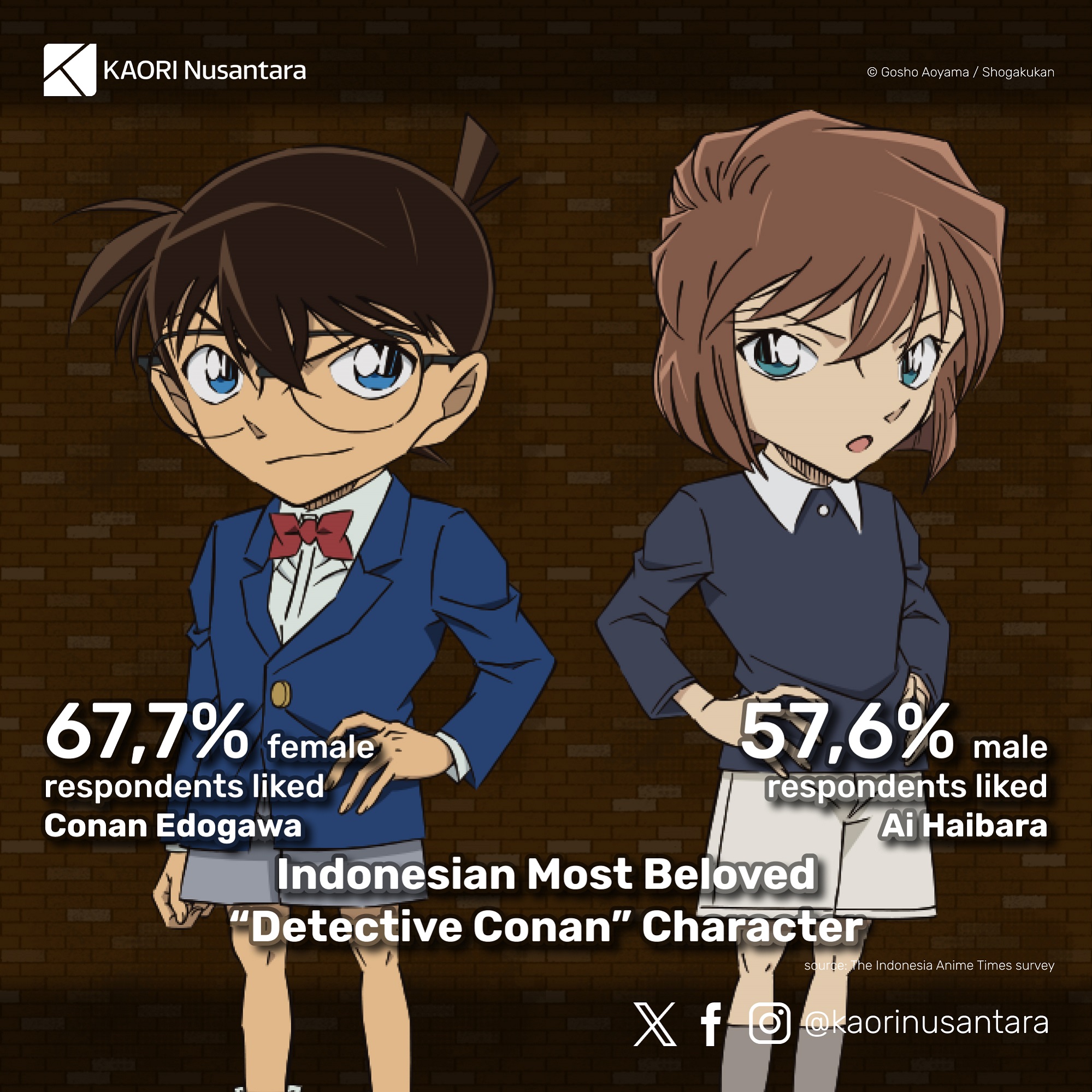
Other popular characters included the FBI agent Shuichi Akai with 108 votes overall and the Phantom Thief Kid with 94 votes overall. Akai was more decisively popular than Kid among the female respondents, with the former receiving 61 votes and the latter 49 votes; while the numbers were closer among the male respondents, with Kid at 40 votes and Akai at 38 votes.
Over the course of the manga, many romantic relationships have formed between the many characters that have appeared. And these romantic plotlines are universally appealing enough to be one of the elements that the fans enjoy the most. Not surprisingly, the pairing of the main character and main heroine Shinichi and Ran was the most popular, with 113 votes overall, 58 of which were from the female respondents and 47 others were from the male respondents. An alternative pairing of Conan and Ai only took tenth place with 25 votes overall. It claimed a similar position among female respondents with 11 votes, but not among male respondents, where the Conan x Ayumi pairing took ninth place with 11 votes.
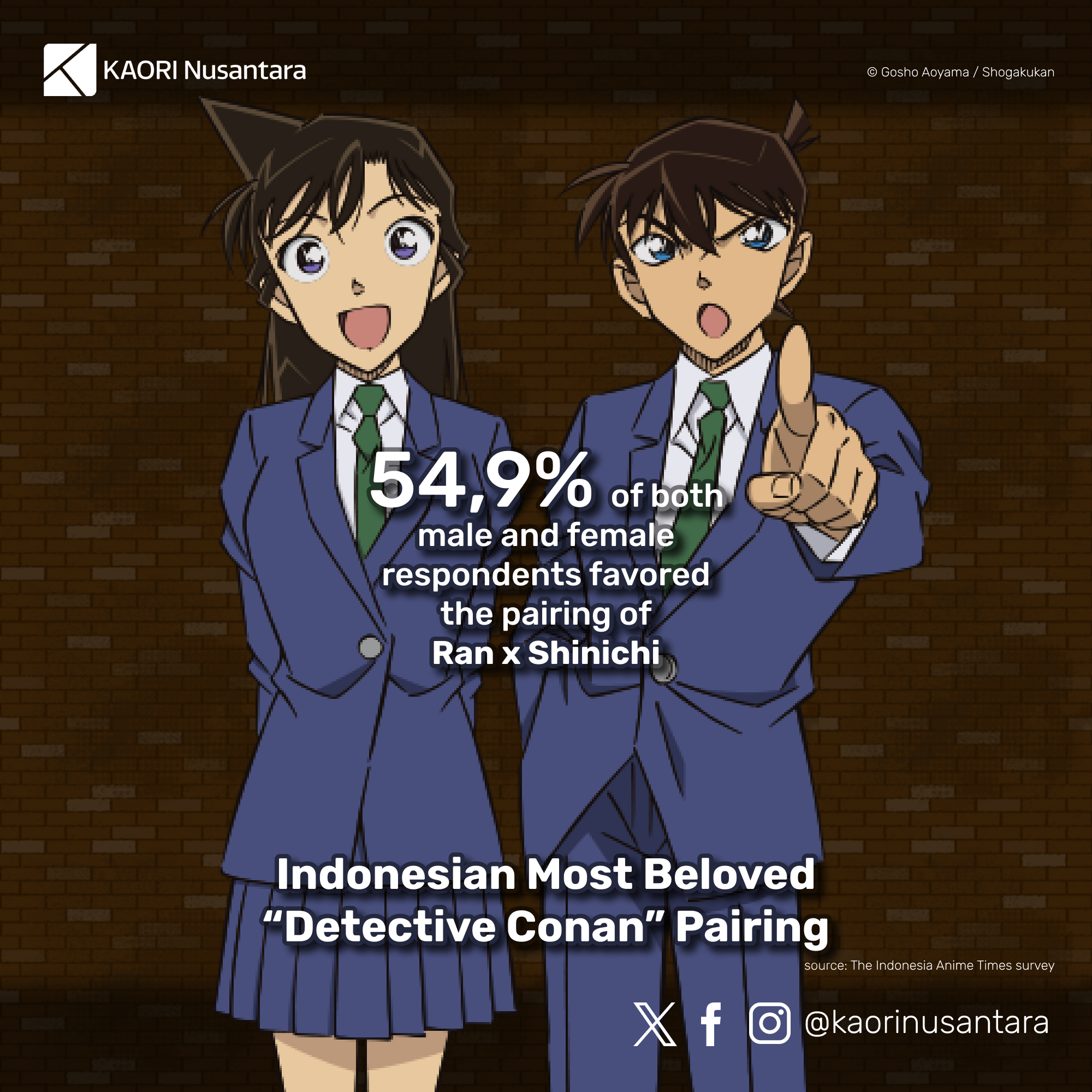
Beyond the main character, other pairings in the top five among both female and male participants were similar, featuring the police couple Takagi and Miwako (82 votes overall), Shinichi’s rival from Osaka, Heiji, and his childhood friend Kazuha (79 votes overall), Shinichi’s parents Yusaku and Yukiko (73 votes overall), and Ran’s estranged parents Kogoro and Eri (56 votes overall). The order of their popularity between female and male respondents was different, though.
For the female respondents, the second to fifth spots were taken by Heiji and Kazuha with 51 votes, then Yusaku and Yukiko with 48 votes, followed by Takagi and Miwako with 46 votes, and Kogoro and Eri with 31 votes. While for the male respondents, the second to fifth spots were claimed by Takagi and Miwako with 30 votes, then Kogoro and Eri with 24 votes, followed by Heiji and Kazuha with 21 votes, and Yusaku and Yukiko pair actually tied at 20 votes with another police couple of Chiba and Miike.
A characteristic of fandom is that they do more than just consume media, and so too the Conan fandom in Indonesia involved themselves in various activities. The most popular among the respondents proved to be discussing theories about the cases and the story, with 110 claiming to enjoy doing it. With the Conan Fans Club helping in distributing the survey, it is no surprise that joining a fan community is another popular response, with 99 responses in total.
Surprisingly, the number of respondents involved in transformative activities wasn’t that many, with only 31 respondents claimed to have made fan art, 19 respondents claimed to have made fanfic, four claimed to have made song covers, and only three claimed to have cosplayed. These were fewer than collecting merchandise with 73 respondents and taking part in watch parties with 46 respondents.
The Conan Fans Club itself began as an online community, originally as a group on a platform called Mig33 founded by Windah Nugraha from Yogyakarta in 2008. As Facebook was growing in popularity, the group migrated to a Facebook fan page in 2011. As the community grew, it began to organise offline activities, like a national gathering at Jakarta’s National Monument in 2014. Following an invitation to attend a screening of a Detective Conan film at a cinema in 2014, the community has made an annual event of organising watch parties of the series’ latest films (only cut off during the pandemic), not only in Jakarta, but also in various cities in Indonesia. And as mentioned earlier, the community has also collaborated with Elex Media for a number of Conan-related events. Not only enjoying the series, but the community’s activities have also included a collaboration with a thalassemia survivors’ group for a blood donation drive.
The Future?
In this coverage, we have looked into who the fans of Detective Conan in Indonesia are, various aspects of their media use patterns and preferences, and some glimpses of their fan activities. With the love and dedication fans in Indonesia have, there’s always the desire for a chance to meet the creator, Gosho Aoyama, himself. This, however, is difficult to achieve in Indonesia as Gosho is too busy to travel abroad. During the aforementioned launch event on 2 February 2025, however, Elex’s editor has mentioned that they could, at least, try to negotiate with Shogakukan for a possible video greeting with the manga artist, though the outcome remains to be seen.
The Indonesian Anime Times